By Joe Fleetwood, National Secretary
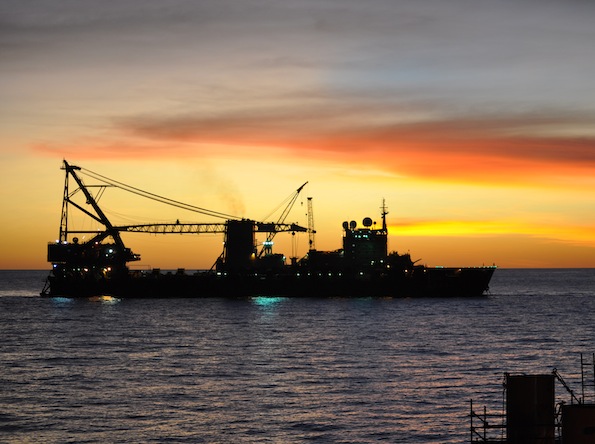
The Maritime Union supports the responsible development of the offshore industry, both for oil and gas, and mineral resources.
We have a very different vision of how those resources should be developed, and how the benefits are distributed, than the current Government and their corporate backers.
Debate on the offshore industry has become polarised between hardened pro and anti drilling and mining positions.
Some of the major issues are being ignored.
On the pro side a number of unrealistic expectations being promoted.
The benefits of developing our maritime resources are numerous. Obviously for seafarers whom we represent there are well paid jobs, and the boost to regional economies can be seen in the case of Taranaki.
Yet there are downsides too, and most importantly the question needs to be asked “who benefits?”
It’s in the interests of the current Government to pump the prospects.
The sad fact is we are heavily reliant on our extractive industries to make up the shortfall for the irresponsible tax cuts and a generation of free market ideology which has created a vast social deficit.
The New Zealand economy is doing great we are told, but unfortunately the people of New Zealand are not doing so well in many cases.
Unemployment remains high concentrated in some communities and has now become an intergenerational threat to our society, along with casualization and low wage jobs.
One thing is for sure that the trickle down effect is not the model we want to follow when it comes to distributing the benefits from the offshore industry.
Look at the United Kingdom, where the benefits of North Sea oil and gas were squandered in the Thatcher years.
A recent article in the UK Guardian by Aditya Chakrabortty (13 January 2014) described how the North Sea billions were transformed into tax cuts for the wealthy, with one economist suggesting the resulting boost in disposable income of the already rich had pushed up house prices. Sound familiar?
In Australia, the miners union, the CFMEU, has shown how the benefits of the “resources boom” have accrued to a minority in their November 2013 report “Sharing the Benefits.”
CFMEU miners leader Andrew Vickers told media “We have experienced a major boom but have relatively little to show from it, other than that it helped us avoid the worst of the global financial crisis …Too much has gone into the pockets of shareholders and management, mostly based overseas, and too little to the Australian community that owns the resources.”
The billionaire mining heiress Gina Reinhart summed up the attitude of this rentier class in 2012 by complaining publicly that Australia was becoming too expensive and too uncompetitive for export-oriented business.
“Africans want to work, and its workers are willing to work for less than $2 per day. Such statistics make me worry for this country’s future,” she announced in a video.
Contrast this bizarre outlook with Norway, with its “integrated, planned approach that created long term industries.”
A generation ago the decision was made to invest North Sea oil and gas proceeds for the long term benefit of the Norwegian people.
Taxes, license fees and income from the majority State-owned producer Statoil have built up the largest pension fund in the world. There is plenty of debate about the fund in Norway, but it’s the about the kinds of problem you want to have.
For a more radical example, the Government of Venezuela has used the income from their oil resources to transform the lives of the poor majority, once denied access to the benefit of their national resources.
Despite the best attempts of destabilisation from the vested interests, Venezuela has pushed forward an ambitious social programme to alleviate the worst of the poverty that scarred its history.
New Zealand could use our offshore resources to benefit all, but under current policy we are more likely to see the benefits go to a few. That’s the debate we should be having.
The opposition to the offshore industry is understandable but on closer examination is illogical and inconsistent.
Oil and gas corporates are not a specifically evil group of entities, any more than any large capitalist corporation.
They are simply profit maximising machines and will do whatever they can to maximize their profits.
Climate change is a reality and a threat to human existence.
The danger of oil spills is real too. But the danger of oil spills is not a New Zealand phenomenon.
New Zealanders will still use fossil fuels and their byproducts regardless of whether we drill. So in a sense there is an element of hypocrisy at play.
There is a disconnect operating here.
The entire New Zealand economy uses oil and gas. It uses minerals. This is not going to change tomorrow or even in ten years time.
We are now plugged into a globalised international economy and to move to a new system requires more than moralistic slogans.
This is not arguing that the global free market is a good thing. The Maritime Union has argued against corporate globalisation and free trade deals, and the worst excesses of contemporary capitalism on workers and the environment.
But we have to work from where we are, not from where we would like to be. To try and separate off from this system overnight is not going to happen. Organic fruit and vegetables are not transported to inner city shops by donkey and cart.
To simply say, let’s stop it, is not feasible.
New Zealand needs a transition plan and the limited use of our offshore reserves over the next period can help pay for this.
For example, due to the backward approach of our Government, we have seen the rapid expansion of roads and the movement of freight by trucks, which objectively speaking is absolutely ridiculous.
New Zealand is a maritime nation and our future lies in the vast oceans that surround us.
So what is the alternative?
The Maritime Union advocates a national strategy to develop of offshore resources, not fritter them away in pumping up the incomes of the already wealthy through unaffordable tax cuts.
A sovereign fund is one option, but given New Zealand’s descent into developing world status in some communities, an immediate programme of raising wages and benefits for the poorest sections of the most disadvantaged is required.
This must be supplemented with an integrated housing, education and health programme to ensure that no New Zealanders are left behind.
Secondly, acknowledging this is not a long term option, offshore income must be directed to a long term strategy with a focus on moving New Zealand beyond a fossil fuel based economy and developing renewable energy generation and a transport system based on low impact coastal shipping and rail.
Finally we must have a unionised workforce which can act as a safeguard to ensure world class health and safety practices.
For example MUNZ suggested prior to the grounding of the Rena the provision of an industry funded fast response vessel to deal with offshore incidents, yet no progress on this has been made by Government.
In addition we have called for the crewing of FPSO vessels used in offshore production with a marine crew of qualified seafarers.
The review of New Zealand health and safety laws following Pike River is important. The hard lesson was that private corporations were allowed through poor regulation and so-called “pro business” policies, to prioritise profit over worker safety. It must not be allowed to ever happen again.
New Zealanders should rightly be concerned about the dangers and downsides of offshore drilling and mining, but used responsibly, these resources could be used to build a post-carbon economy and overcome poverty and want in New Zealand.
There is a balance to be found, but we cannot allow the benefits of our offshore resources to be squandered.