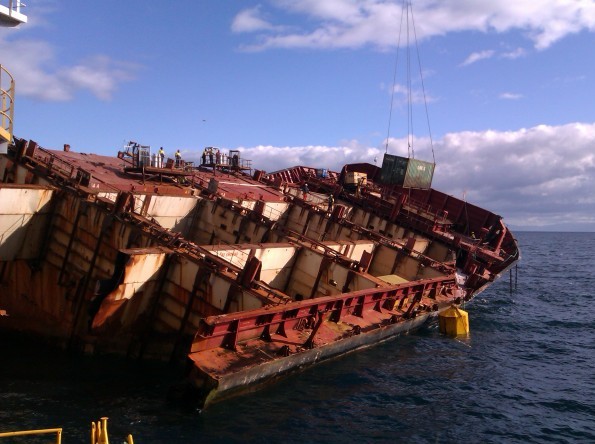
The Maritime Union is calling for a complete overhaul of New Zealand shipping policy to avoid a repeat of the Rena disaster.
Maritime Union of New Zealand General Secretary Joe Fleetwood says the main problem is that New Zealand desperately needs a shipping policy.
Mr Fleetwood says the jailing of the Rena’s Master and Mate was a case of attacking the symptom but not the disease of deregulated Flag of Convenience shipping (Editorial note: see more information about Flag of Convenience shipping below).
“The approach for the last generation has been for Government to abdicate its responsibility to ensure standards in the maritime industry.”
As long as Flag of Convenience shipping was given a “free ride” in New Zealand waters, Rena style incidents were “almost guaranteed”.
“The surprising thing is how long it took for a shipping disaster of this type to happen, not that it did happen.”
Mr Fleetwood says the Australian Government this week passed Shipping Reform Package bills to regenerate Australian owned and Australian crewed shipping.
New Zealand, by contrast, was still locked into failed deregulation policies from the 1980s.
“Do we need more Rena style disasters to get the same action on merchant shipping in our waters?”
Mr Fleetwood says the reintroduction of cabotage (giving priority to New Zealand owned and crewed shipping) was now back on the agenda following the Australian developments.
He says that it was extremely disturbing that a maritime trading nation like New Zealand was now completely dependent on global shipping lines and Flag of Convenience vessels.
“We need a New Zealand shipping line to ensure our maritime and economic security.”
There were a number of other basic changes that could be easily made to rapidly improve safety in the industry, such as the mandatory use of dedicated shipping lanes, which could have prevented the Rena disaster.
Greater regulation of shipping was required to monitor fatigue, safety standards, and the condition of vessels.
“The crew are under enormous pressure for faster turnarounds from the owners. In this environment, errors and bad judgement will continue.”
Increasing the liability on the owners and charterers of vessels was obviously required.
The Maritime Union had also lobbied the Government previously to the Rena Disaster for the provision of a quick response vessel to assist for shipping or offshore oil and gas industry emergencies.
Mr Fleetwood says the deregulated and “toxic” competition in the entire maritime industry was responsible for many problems in shipping and ports.
He says the recent moves to remove foreign flagged charter vessels from the New Zealand fishing industry were an acknowledgement of the crisis in the wider maritime industry.
The changes had vindicated a long running campaign by the Union to get the fishing industry cleaned up.
The problems experienced with Flag of Convenience shipping in New Zealand waters had many similarities, and had to be dealt with in the same way.
Mr Fleetwood says the Maritime Union welcomed the growing political support for New Zealand shipping from opposition parties.
What is Flag of Convenience (FOC) shipping?
A flag of convenience ship is one that flies the flag of a country other than the country of ownership.
Cheap registration fees, low or no taxes and freedom to employ cheap labour are the motivating factors behind a shipowner’s decision to ‘flag out’.
Some of these registers have poor safety and training standards, and place no restriction on the nationality of the crew. Sometimes, because of language differences, seafarers are not able to communicate effectively with each other, putting safety and the efficient operation of the ship at risk.
In many cases these flags are not even run from the country concerned.
Once a ship is registered under an FOC many shipowners then recruit the cheapest labour they can find, pay minimal wages and cut costs by lowering standards of living and working conditions for the crew.
Globalisation has helped to fuel this rush to the bottom. In an increasingly fierce competitive shipping market, each new FOC is forced to promote itself by offering the lowest possible fees and the minimum of regulation. In the same way, ship owners are forced to look for the cheapest and least regulated ways of running their vessels in order to compete, and FOCs provide the solution.