
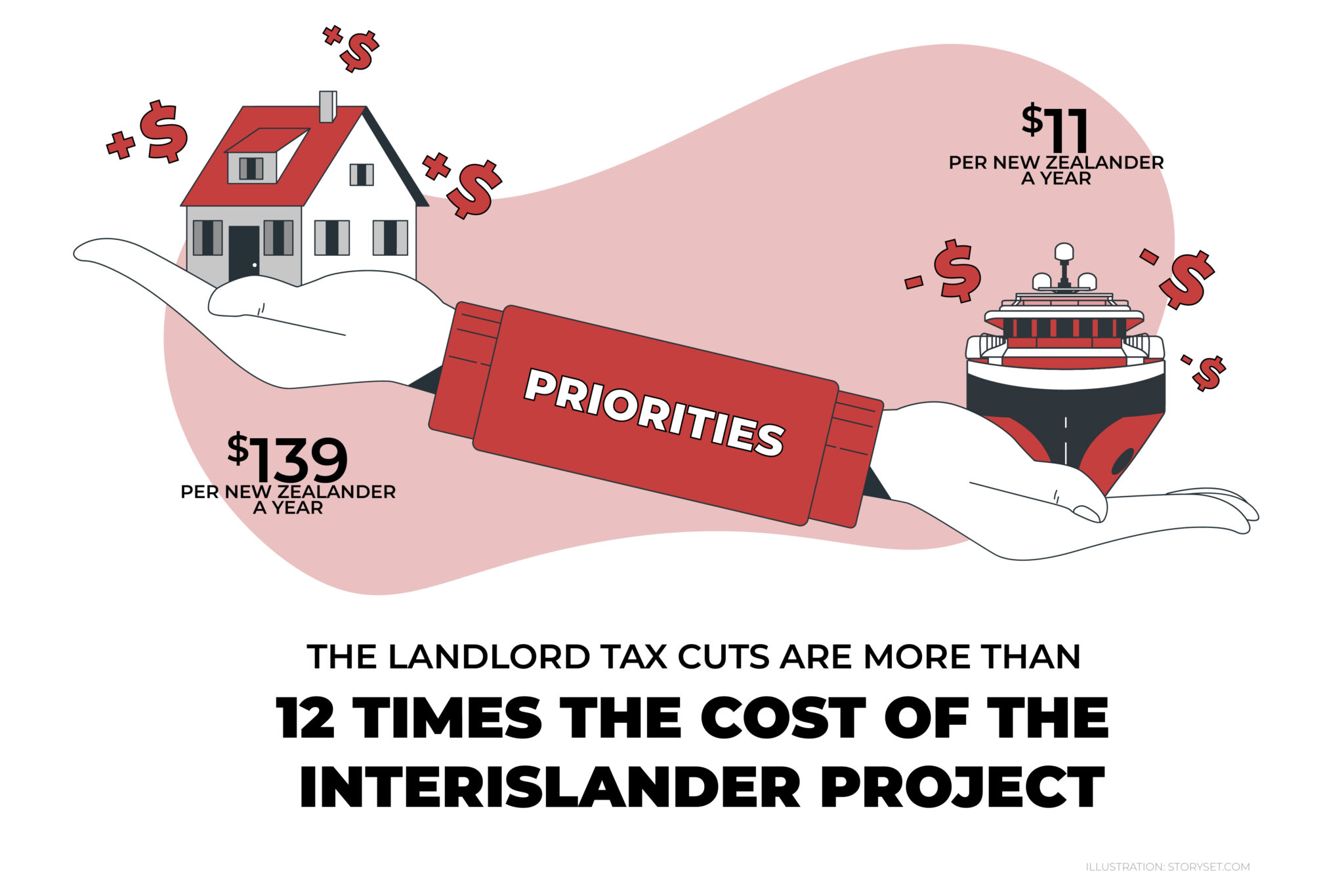
New analysis from the CTU shows the cost of the Government’s tax cuts for landlords will be many times more than the investment required for the much-needed Cook Strait ferry upgrade.
This shows the Government making a clear choice to back unproductive investment in property over investment in critical infrastructure that would help grow our economy and support business, says CTU Economist Craig Renney.
“National says the Inter-island Resilient Connection project is too expensive, but our analysis shows that, over the lifetime of the assets, the cost is only around $11 per New Zealander a year in today’s dollars. Contrast that to the landlord tax cuts, which would cost $139 per Kiwi each year. Landlord tax cuts are more than 12 times the cost of the Interislander project.
“This Government was elected with the slogan ‘get our country back on track’ – yet one of its first acts is to derail a vital transport link between the North and South islands, which carries $14bn of freight and 850,000 people each year.
MUNZ National Secretary Craig Harrison says “The upgrade of the Cook Strait ferries is not an option for New Zealand, it has to be done. The regular technical problems experienced by the ferries are a result of using end-of-life vessels in a challenging maritime environment.
“The failure to modernise this essential infrastructure leaves New Zealand exposed to further delays, service outages, expense for industry, and serious safety issues for crew and passengers. The Government’s decision sets back New Zealand’s transport resilience and will set New Zealand back.”
RMTU General Secretary Todd Valster says “The Government has stated they want KiwiRail to provide a safe and resilient service but that conflicts with aging ferries due for replacement. KiwiRail has had rail-enabled ferries since 1962. Ferries that are rail enabled allow rail freight to be moved without freight having to come off rail wagons to travel the Cook Strait. Rail-enabled ferries are safer and more efficient to load and unload. The proposed new ferries would have produced 40% fewer emissions, and the hull is designed to have a lower impact on the marine environment”.
Craig Renney says “This is a government that claims it is economically responsible while it guts New Zealand’s freight capacity and spends billions on unproductive tax cuts for property speculators. For the future prosperity of our nation, New Zealanders need to be able to move themselves and their goods around the country in ways that get easier over time, not harder. The Government should urgently reverse this mistaken decision at the mini-Budget this week.
CTU analysis
We have modelled the costs associated with the $3bn programme over a 50-year average life of the assets, using a 4% interest rate which is above the long-run average for long-term New Zealand Government bonds. This conservative analysis makes no assessment of the likely economic benefits of more regular, safe, and reliable crossings, which is likely to be in the range of many billions in the period. Nor does it make any assessment of the cost of leasing the replacement smaller ferries over the same period, which again is likely to be in the low billions.
This assessment also makes no analysis of the environmental costs of taking freight off rail, the extra roading costs associated with more trucking, nor the continuing use of less efficient ferries that produce higher emissions. All of which are likely to be very significant.
We have also examined the cost of restoring interest deductions for landlords over the same period. We have not assumed any new landlords or any new growth in the rental market, simply that the cost of the policy rises with inflation. This is very likely to be an underestimate of the real cost of the tax cuts.
We used the base case population forecasts from Statistics New Zealand.
Nominally, the Inter-island Resilient Connection would cost on average $19.55 per person, per year over its lifetime. Adjusting for inflation over the fifty-year period, this would fall to an average $11.12 per person, per year in 2025 dollars. The landlord tax cut costs an average of $232 per person, per year before inflation adjustment. After adjustment, each New Zealander would be paying $139 per person, per year in 2025 dollars.


One Response
This is just another example of neo liberal economic policies that favour the rich over the working class. How can any sane person support a tax gift to landlords/property developers over an essential transport system between two islands! The transport system employs more workers than landlords tax breaks! This just another example of a conservative Government adopting the failed drip down economics throughout the world!