

The Maritime Union of New Zealand (MUNZ) is welcoming the release of the New Zealand Infrastructure Commission’s new report, Nation Building: A Century and a Half of Infrastructure Investment in New Zealand, but says it has a glaring omission by ignoring the country’s ports and maritime sector.
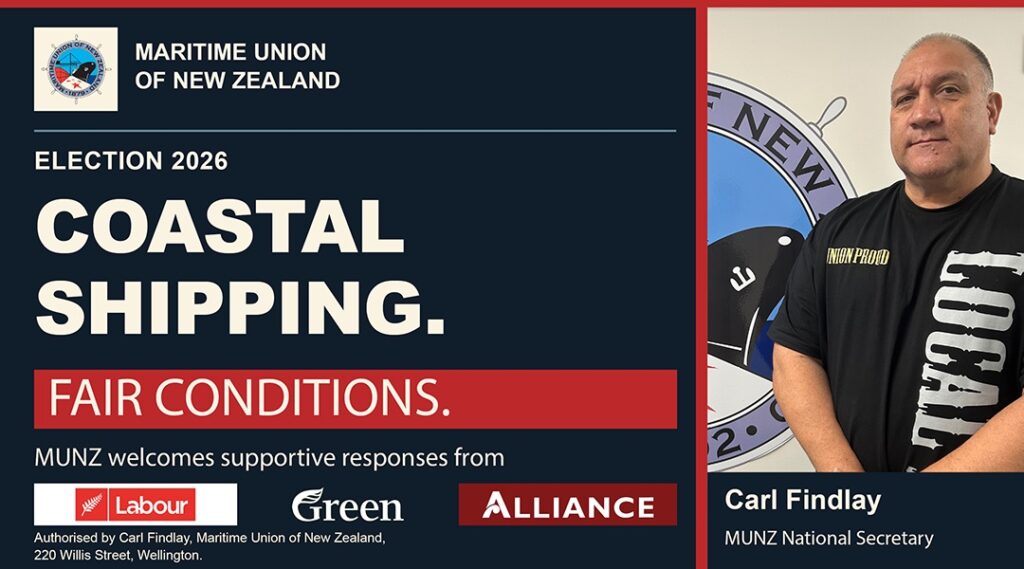
MUNZ National Secretary Carl Findlay says while the overview of infrastructure investment is valuable, it is incomplete without considering assets that handle nearly all of the country’s international trade.
“Nation building must include the infrastructure that connects our island nation to the world and to itself,” says Mr. Findlay.
“Since the nineteenth century, our ports have been our primary economic gateways, along with the shipping that services them.”
Ports are New Zealand’s economic lifeline, with 99.8% of exports and 99.6% of imports by volume moving through them in 2024.
MUNZ argues that ports are the linchpin of a successful transport policy.
The Union is advocating for a National Ports and Coastal Shipping Strategy to end the “pointless competition” between ports, which leads to misallocation of capital, duplication of infrastructure, and gives undue market power to international shipping lines.
“Our current port system encourages wasteful spending and leaves our regions vulnerable. A coordinated ‘hub and spoke’ port model, would create massive efficiencies, enable better infrastructure planning, and realize the potential of coastal shipping,” says Mr. Findlay.
MUNZ’s submission to the current Parliamentary Inquiry into the ports and maritime sector outlined how a hub-and-spoke system would connect international hub ports to regional ports via a revitalised New Zealand flagged and crewed coastal shipping fleet.
This would reduce congestion and maintenance costs on road networks, lower greenhouse gas emissions, create skilled local jobs on the coast and in regional ports and improve the resilience of our national supply chains in emergencies.
“A coordinated national ports strategy, supporting coastal shipping, is the single biggest transport infrastructure opportunity for New Zealand,” says Mr. Findlay.
The Maritime Union is calling on the Government and the Infrastructure Commission to recognise ports and coastal shipping as critical strategic infrastructure and integrate them into the upcoming National Infrastructure Plan.