The Maritime Union has attacked what it describes as the “narrowness of vision” in yet another report into the state of New Zealand’s ports.
Maritime Union General Secretary Joe Fleetwood says the Ministry of Transport commissioned Freight Futures report travelled down well worn paths and added little to the debate.
He says the latest report promotes a free market agenda that was now globally discredited and driven only by corporate self-interest.
Possibly the intent of the report was to provide justification for the continuing “avoidance” approach of the National Government to ports policy – which could be summed up by the words of the song “What ever will be, will be.”
Mr Fleetwood says the new NZIER report repeats material from the recent Port Performance and Ownership report to the Local Government Forum, which represents big business and private sector interests.The report was biased against workers in the industry who it portrays as a problem, was hostile to public ownership and had a “thinly veiled contempt” for democratic institutions like local Government.
Claims that New Zealand port performance had been harmed by the Employment Relations Act were not accurate or backed with any substantive evidence.Mr Fleetwood says he is concerned that the reality of reduced pay and conditions, continuing health and safety issues, and the destruction of career paths and secure jobs for young workers in the ports industry, were not covered by the report.
He says the regular deaths and injuries of workers in the maritime industry, including overseas crews, showed a human cost to the so-called efficiencies of the free market.
“They didn’t put anything about that in the report though, as the lives and wellbeing of the workers in the industry do not seem to come into the equation.”“All it shows to me is that this is the usual bloodless and dry approach by people who have nothing to do with the industry and for whom short term profit is the only measure of success.”
“The authors of this report obviously have no understanding of how the increased usage of poorly trained and unskilled casual workers, and difficult and unsafe working conditions on some older and smaller ships calling at our ports, can impact on these statistics.”
The smaller size of New Zealand ports was just one reason why so-called efficiency comparisons with huge global terminals overseas was misleading.
These “underproductivity” arguments are rejected by many in the industry, and Fonterra’s General Manager of Logistics Nigel Jones had publicly responded to similar claims in a previous NZIER report by stating it was dangerous to look at issues such as crane productivity in isolation, because ports were part of the supply chain.
Mr Fleetwood says as taxpayers and wealth producers, maritime workers object to subsidizing reports by people who are remote from the everyday reality of our industry.
The Maritime Union has proposed an active maritime and ports policy rather than the fatalistic approach of the current Government.“We propose ‘KiwiPort’ a national ports plan, cabotage for coastal shipping and the investigation of New Zealand investment in shipping for our global trade routes.“The growth of specialist areas such as the offshore industry also had the potential for developing a high skill industry, and needed to be factored into any maritime policy.
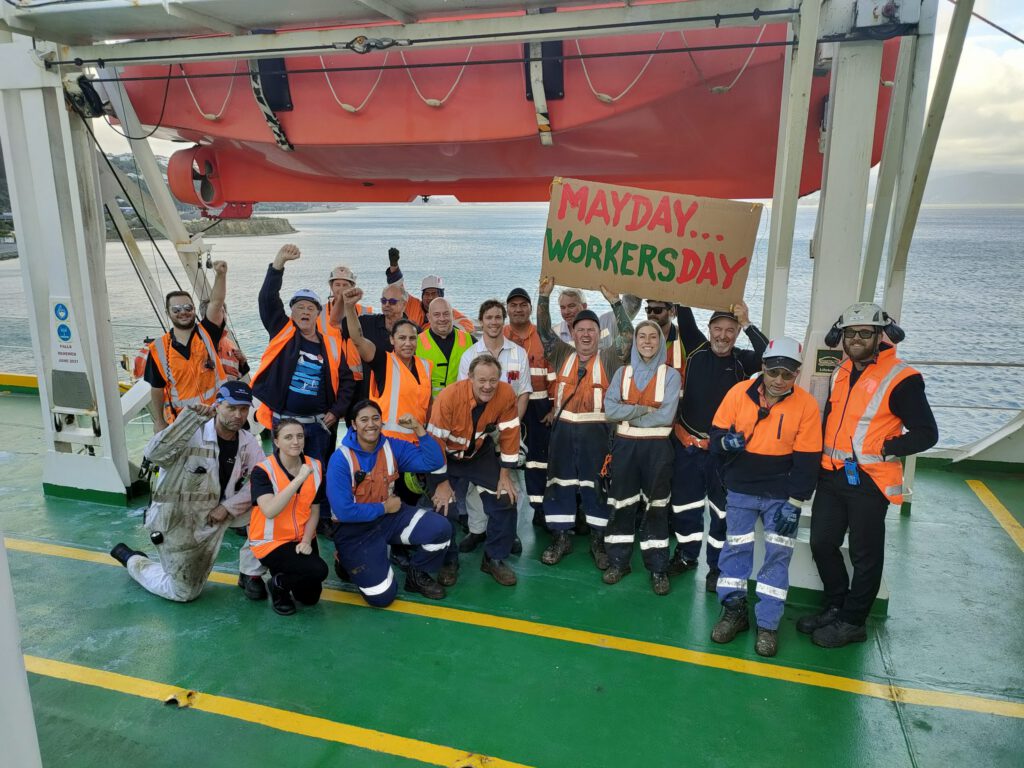
Welcome to the Maritime Union
The Maritime Union of New Zealand was formed in 2002 when the New Zealand Waterfront Workers’ Union and the New Zealand Seafarers’ Union joined together. We represent waterfront workers, seafarers and related workers in New Zealand.