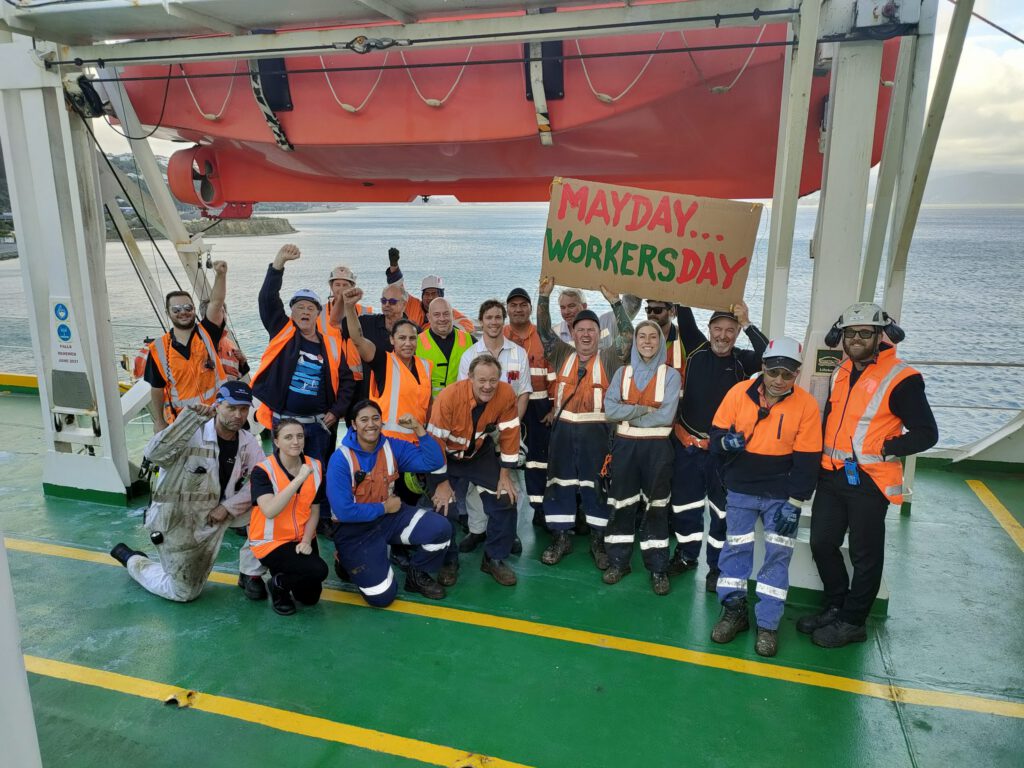

The Maritime Union of New Zealand (MUNZ) has responded strongly to claims of a “productivity crisis” in New Zealand ports.
MUNZ National Secretary Carl Findlay says New Zealand’s supply chain vulnerability has its roots in the lack of a national ports and coastal shipping strategy.
“New Zealand doesn’t have a port productivity problem – it has a shipping problem and a failure by Government to provide leadership,” says Mr Findlay.
He says the reliance on ‘market forces’ to drive our supply chain and port infrastructure has been a failure, which has allowed powerful global shipping lines to dominate our import and export trade.
Mr Findlay says ports have been set up to engage in parochial competition against each other, with international carriers able to dictate terms and abandon services at a moment’s notice, leaving regions stranded.
“This has led to misallocation of capital by individual ports in infrastructure, and a constant downward pressure in industry wages, conditions, safety and job security.”
MUNZ has repeated its calls for a nationally coordinated ‘hub and spoke’ port strategy backed by New Zealand coastal shipping.
This would see international vessels call at several key ‘hub’ ports, with a revitalized fleet of New Zealand-flagged and crewed coastal ships servicing the regional ‘spoke’ ports, says Mr Findlay.
“This integrated system would keep our ports in public ownership, build supply chain resilience, reduce congestion on our roads, and create skilled maritime jobs for New Zealanders.”
Mr Findlay says a one-sided emphasis of putting speed before safety on New Zealand’s waterfronts had led to a health and safety crisis.
“When business lobbyists talk about ‘efficiency’ and ‘productivity’, they are often talking about cutting corners on safety. We’ve seen this before in New Zealand, and it has come with a terrible cost.”
“The lessons from the Pike River tragedy were that you cannot have a ‘production before people’ culture.”
Mr Findlay says the recent turnaround at the Port of Auckland is proof that working collaboratively with a unionized workforce is the key to a successful and productive port.
“The new management team at Port of Auckland chose to work with the Maritime Union through a Tripartite Accord. The result is a dramatically safer workplace, record profits, and improved productivity,” says Mr Findlay.
Under the collaborative model, Port of Auckland has seen a 55% increase in underlying profit and a 5% rise in container volumes in the last financial year, while significantly improving its safety performance.
The Maritime Union is urging the Government to show leadership in ports and coastal shipping, and has submitted its national port and coastal shipping strategy to the current Parliamentary Inquiry on the Ports and Maritime Sector.